Thursday, September 22, 2016

Getting My Just Deserts. - Calibirdication Day 5

After three days in the desert fun
I was looking at a river bed
And the story it told of a river that flowed
Made me glad to see all the birds getting wet


Tuesday August 23

One thing I have learned about finding hard to locate nemesis birds, is that you must plan multiple modes of attack. From the site's description, we should have had Le Conte’s Thrasher in Borrego, and yet we did not.

Dunlin Schulman had suggested Piute Ponds. I also heard that she had tried for the Thrasher at Borrego and also did not get it. Upon return home I heard from Peter Shorebirder and he too did not get the Thrasher at Borrego. So note to readers, try elsewhere if you want that bird!

We awoke early to get a head start on the desert heat. We were not too far away, and having gotten permission and access to the ponds we entered the facility. This facility is on military property, it is imperative that you get permission first. It is not difficult to do, other wise you might get shot. Not by the military, but by birders who would be upset if you ruined access for them.

During my preparation I discovered that LA Audubon was having a walk at the ponds a few days before when I had it scheduled. Reaching out to the leader of the trip was great because he gave me a map of the place with descriptions on the areas where he typically found the thrasher.

There are a lot of ponds and trails in this wetland that is within Edwards Air force Base. Driving the road to the parking area we stopped frequently to check out the activity which included Loggerhead Shrikes, and in sharp contrast to Borrego, this place was teeming with life - birds were everywhere. Marsh Wren sang from the sedges, and Red-winged Blackbirds flew all about. We set out on the Duck Bill Pond loop and quickly added a lot more species. Lisa stayed behind because she wanted to get some photos of the birds near the parking lot, while I pressed on in search of my quarry.  


Song Sparrow


Black-necked Stilt
A Horned Lark was a surprise, but BC Night Heron and Green Heron were very much at home. There were a lot of Egrets and even more Stilts. White Pelicans and ducks of the Ruddy and Shoveler variety were present, as well as Song Sparrow, Common Throat, and Great-tailed Grackles, again the latter without great tails. 

Green Heron (L)           Black Crowned Night Heron (R)

We walked the trail to the north west corner of the pond. We got great looks at Bell’s Sparrows, but no thrasher, and this was supposed to be the spot they were usually found.  We continued east. Along the way we had good looks at Western Meadowlark, a lifer for Arlene. There were Western Kingbirds fighting in the tree tops, and some Ash-throated Flycatchers as well. An Empid was feeding, we wanted to know who it was, but it wouldn't talk with his mouth full.  

Empid sp. Hammond's? Willow?
About midway east was the other recommended location, and still a no show. In the water were White-faced Ibis and White Pelicans, and a bonus bird was a Franklin’s Gull. We also scared a rather largish bird out of the tamarisks, and though it was distant I was able to get a view in my scope.

It was a Great Horned Owl! The ID was made difficult by the heat shimmer, and some sort of malfunction with my telescope. I discovered that my eye-piece cover had gotten lodged inside. I had removed the eye-piece for travel, covering both ends with its caps. When I had placed it back on the scope I neglected to remove the inner cap and it came off and got lodged inside. Oh yay. 


Squirrel species on sentry duty
So for the rest of the trip I could not focus to the extreme as the cap was interfering with the mechanism. Fortunately Arlene got her new fancy shmancy Vortex scope and I have to say that it is quite impressive. It too has a 20-60 zoom, but the field of view appears larger. One detraction is that I am not a fan of angled scopes; I prefer straight through. So scope wise all was not lost.

But I was still thrasher-less. When we got to the north east corner we stopped when we saw Lisa approaching from the south. I yelled "Run!" but Arlene smacked me for some reason. We then noticed that Lisa was approaching with another person, so we waited for them to see if they had anything interesting to relay. Lisa told us of the good birds she had in the pool south of us, but the other birder was new and green and nice enough but not terribly informative.

Told of our Meadowlarks, Lisa wanted to head the way from whence we had come. Jeff wanted to see the birds she mentioned and continued on. I wanted to give the thrasher another chance, and so did Arlene, so the three of us back tracked to find Lisa the birds she wanted and attempt to relieve my lifer desperation.

We found Lisa the Meadowlarks, but not the Thrasher. We continued west to the other spot and we looked around, enjoying the Bell’s Sparrows that were chasing each other around. I was becoming a bit worried that I would be skunked yet again, and then I heard a unique call. I asked Arlene who has far superior hearing to that of mine, if she was hearing the call and she said yes, and its definitely the bird! WHERE IS IT COMING FROM? I somewhat excitedly asked, and she pointed to the tamarisks ~behind~ us. We had been looking out into the sage and creosote, but this bird was grooving in the shade of the dense tamarisk.  


The Tamarisks.

The sign. 
We then also heard it sing! The best part was with Arlene’s acute hearing she was able to pinpoint a location for us and when the bird popped out briefly, we were able to get a satisfying look!! Nemesis no more :)  YAY!!  { note two exclamation marks } The elusive Le Conte's Thrasher was a nemesis no more; worth saying twice. The photos above show the sign where we had the bird, it occurs to me that there should have been a cut out of a Thrasher here, just like they had done at Tijuana Slough for the Ridgway's Rail.

Elated, we made tracks to join up with Jeff. Together we all got nice looks at both Western and Clark’s Grebes, and an Eared Grebe as well. Lisa found a tree with some activity and we got Wilson’s and Yellow Warblers.  


Clark's Grebe

Western Grebe
Satisfied by the success of our morning’s birding, we moved on as the midday sun was a bit much. We made a brief stop at Quail Lake, but only scored Brewer's Blackbird and Ravens.

When we arrived in Lebec we checked into our lodging. It was also a -gasp- Motel 6 and I had an uneasy feeling about it. Once I spoke with the manager and she checked us in, my fears were allayed. She was very professional, the rooms were quite nice, and she offered good advice on places to procure victuals. Quite, and I mean quite, the contrast from the experience in Palmdale. That’s the thing with this chain in particular: some can be quite nice, clean, and modern and others are shit-holes. The benefit of online reviews is only so helpful because many of the reviews are plain useless.

We got Brewers Blackbird and of all things a lone Starling in the hotel parking lot. We then grabbed a quick lunch at Jack in the Box, a place we would frequent all to often on this trip, and headed up Mt Pinos. On the way we had California Thrasher and a covey of California or Mountain Quail, but they didn’t give me the best look or ID ability opportunity. 


Western Bluebird
At McGill campground we found the place deserted of both people and birds. But we walked about and slowly but surely, just like in Munchkinville, the residents made themselves visible.  There were Mountain Chickadees, Steller’s Jays, and a House Wren that loved playing hide and seek with us in the underbrush. The Western Bluebirds were nice, and the Pygmy Nuthatches were very noisy and thus begging us to look at them.  


Mountain Chickadee


One of the birds I had promised the others was the White-headed Woodpecker. This was supposed to be a good place for them; the places I had good luck with them in the past were not on our route. We met the ‘camp host’, the person who stays at the campsites and helps with things that campers may need and is mostly a 'presence'.

He knew about the woodpeckers we were looking for, but offered that he only sees them in the spring, and they are noisy and flying all around the campsite. Doh! Well undaunted we thanked him for the info and continued birding about the place. And then Arlene spotted one! We played hide and seek with this bird too as it alternately looked at us and then moved just out of view behind the trunk before flying off to other trees. 


White-headed Woodpecker
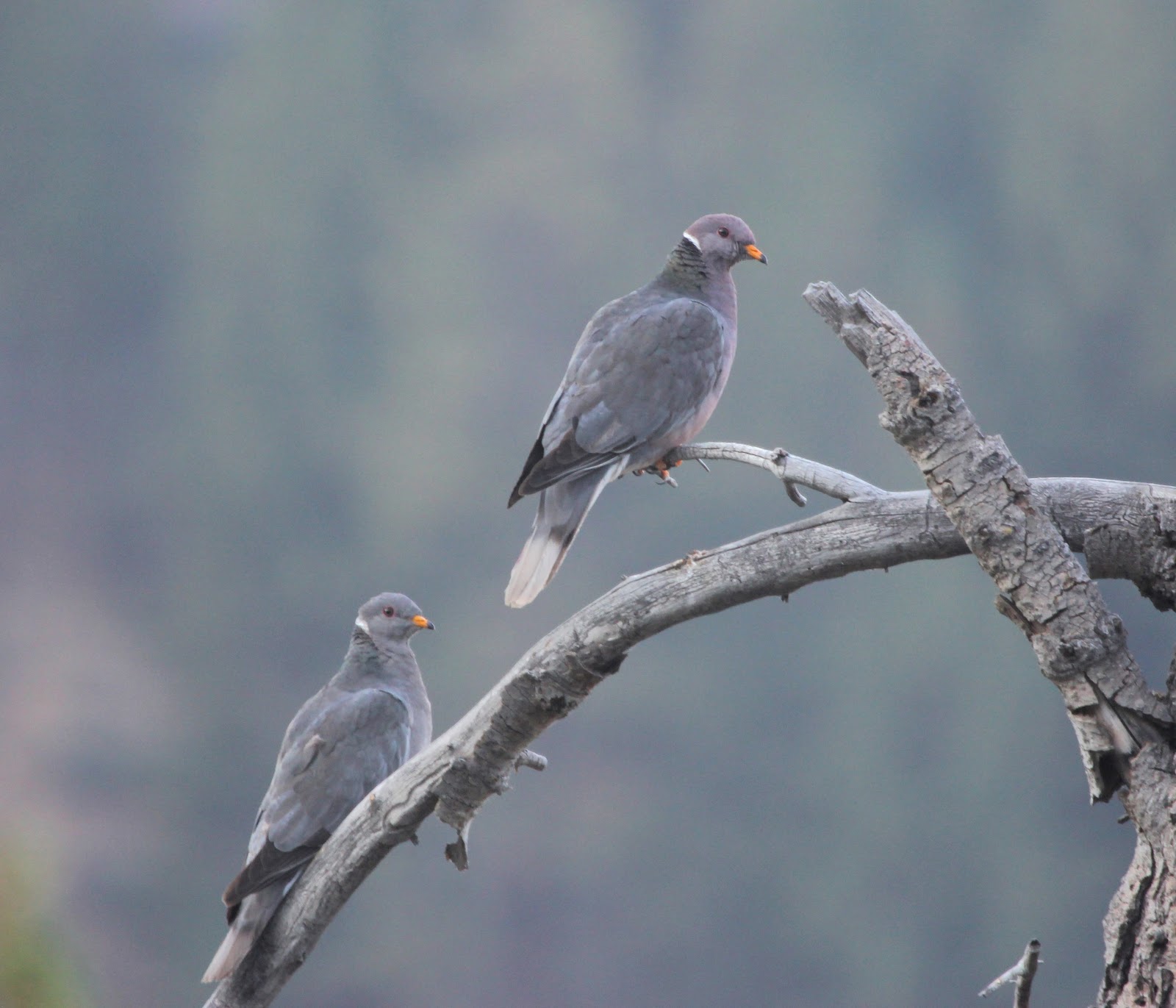
Arlene then spotted some other birds and asked me if they were just MODOs. A concerted look into awful lighting was made, but it appeared that they were not and by moving to a more opportune location I confirmed that they were two Band-tailed Pigeons!  Elsewhere we would find a whole bunch more; interesting because at times it can be a tough bird to find.  

Band-tailed Pigeon
We moved on to a few other locations while there was still daylight where we added the soon to be once again Audubon’s Warbler, Brown creeper, Orange-crowned Warbler, Western Tanager, and Clark’s Nutcracker. 

rodents are so dam cute

Clark's Nutcracker
On the way down the hill I spied something out of the corner of my eye, and we decided to backtrack a bit to see if we could locate it. We did. It was the first of many Acorn Woodpeckers we would have on this trip, but this one was a lifer for Arlene. One must be careful as a birder to not utter the deadly kiss of death phrase: “Oh don’t worry, we’ll see plenty of them”. I was taking no chances. 

Acorn Woodpecker
After freshening up at the hotel, we went out for a superbly tasty meal at the nearby Los Pinos Mexican restaurant. A hearty meal, a celebratory beer. What could be better?

Tuesday, September 20, 2016

Horses Without Names. - Calibirdication days 3 & 4

The ocean is a desert with it's life underground
And a perfect disguise above

What is a birding trip to California without a pelagic or two? I had actually looked into trying to make it three but it just wouldn’t gel. In the morning the four of us walked leisurely to the boat which was a block or two away from our lodgings. Lisa wanted to get a good spot, but the rest of us were just looking forward to being out on the Pacific and seeing some good birds.

Lisa finds a good spot
There is something that is very compelling about the ocean. I have always been drawn to the water and cannot conceive of living away from the coast. And though I enjoy being on the water I do not spend as much time out there as I would like, and so I am in a constant state of wanting more.

One thing I have come to terms with long ago is that occasionally enough, I can fall victim to mal de mer. I have a large bottle of generic Dramamine, it cost me $5 for 100 tablets, and I use it. Problem solved. I am always perplexed by the amount of discussion that ensues on these trips and this one was no exception. Just take a ^%$^t Dramamine and be done with it already. Sure it makes you drowsy a bit, but that sure beats begging someone to kill you to put you out of your misery. Much to my delight, I have discovered that at least for me, having a beer negates the drowsiness by some unknown mechanism. Yay! { That’s my story and I’m sticking to it!}

This trip was out of Point Loma in San Diego, where the fishing is apparently very very good! Huge crowds were assembled for the fishing trips daily, and they returned with very large fish, note to self for alternatives to birding encompassing all the allotted time on a vacation.

The trip was “San Diego County Waters to the 9-Mile and 30-Mile Banks”, with likely species listed as Pink-footed, Sooty, & Black-vented Shearwaters, Black Storm-Petrel, Brown Booby, Red-necked & Red Phalaropes, Pomarine & Parasitic Jaegers, Cassin's Auklet, Sabine’s Gull, Common Tern. The possible species were Black-footed Albatross, Northern Fulmar, Flesh-footed & Buller’s Shearwaters, Leach’s, Least, & Ashy Storm-Petrels, Red-billed Tropicbird, South Polar Skua, Long-tailed Jaeger, Craveri’s & Guadalupe Murrelets, and Arctic Tern.

My personal targets were Flesh-footed Shearwater, Least Storm-Petrel, Red-billed Tropicbird, Craveri’s & Guadalupe Murrelets. I was especially hoping for one or more of the recently split Storm-Petrels such as Ainley’s or Townsend’s. Most if not all of the species were targets for the others.

We began with a slow cruise out the harbor with a stop to admire an impossibly beautiful albino Brant’s Cormorant. It posed majestically for us in the morning light.

albino Brant's Cormorant
We followed a programmed course that took us over various underwater features. Though invisible to us, the underwater features were well known and the bird life above said features were remarkably predictable. Some folks aboard even had a map / GPS app that showed the underwater topography corresponding to our location.

The first good birds we had were Brown Boobies. They are now nesting on the islands in Mexican waters, but frequent the San Diego area. They buzzed our boat as we were exiting the bay. 


Brown Booby
As we got to the ocean proper, we saw our first Black-vented Shearwaters. These are quite abundant birds, and one can often see them in numbers even from shore.

Black-vented Shearwaters
We also saw a lot of Phalarapoops. Mostly Red-necked, but a Red here and there, but the latter was not so easy to pick out. I suppose they are not as small as the smaller pelagic birds, but it still gets me that these small ‘shorebirds’ hang out so far from the shore and in such deep waters.

Red-necked Phalarope
Other shearwaters we were looking for were further off shore and soon we were joined by Pink-footed Shearwaters. Some shearwaters were cavorting with the dolphins.

Pacific White-sided Dolphins
This is what the shearwaters probably thought of us

Take that!
Of course it was the storm petrels I was after, as they had just been split. But the Leach’s were very wary and stayed way out and ahead of the boat. Not the type of views I wanted, but I did get a glimpse at what the experts aboard called a “Chapman’s” race of Leach’s Storm-Petrel. At a later time someone called out that they had a Townsend’s, but I could not get on that distant bird, and even if I could it would not be identifiable in a life bird sort of way.

A difference from previous west coast pelagic experience was almost missing small storm petrels. We did have a few Black Storm-Petrels, but not the numbers I had in the past, and a few very distant Ashys that I never saw, nor heard about at the time.

Black Storm-Petrel


There were some ‘barren’ patches where we were cruising for quite some time without seeing anything, but then we came upon some feeding activity and the Black-vented Shearwaters posed for us on the surface, and then we were joined by Sooty Shearwaters tussling with the Western Gulls. 


Sooty Shearwater (L)     Western Gull (R)
By far the best bird of the day for me was Craveri’s Murelettes. They are small black and white birds that you see in the distance as they take off from the water and fade to an imperceptible speck before you loose them in the wave crests.

The first Craveri’s were found by the Brit, and I got a glimpse before they disappeared. But in the same region we located others and I actually got a good look. They were not so accommodating that I was able to risk taking my eyes off of them to try getting a shot, but I opted for a good look and cannot complain. It was an actual factual full fledged honest to goodness all American {complete with apple pie consumption and pick-up truck driving } lifer! YAY! {notice all caps}

So I am now up to 3 life birds. Can I keep up the pace? The next day calls for an all out assault on a long time nemesis bird, the Le Conte’s Thrasher. Once we got back to shore we had dinner and headed out to the desert for much needed rest and preparation for an early start.


On the first part of the journey
I was looking at all the life
There were plants and birds and rocks and things
There was sand and hills and rings
The first thing I met was a fly with a buzz
And the sky with no clouds
The heat was hot and the ground was dry
But the air was full of sound

I've been through the desert on a horse with no name
It felt good to be out of the rain
In the desert you can remember your name
'Cause there ain't no one for to give you no pain
La, la, well maybe Lisa...


We got up and out before dawn, and made it to the desired location as the sun was rising.

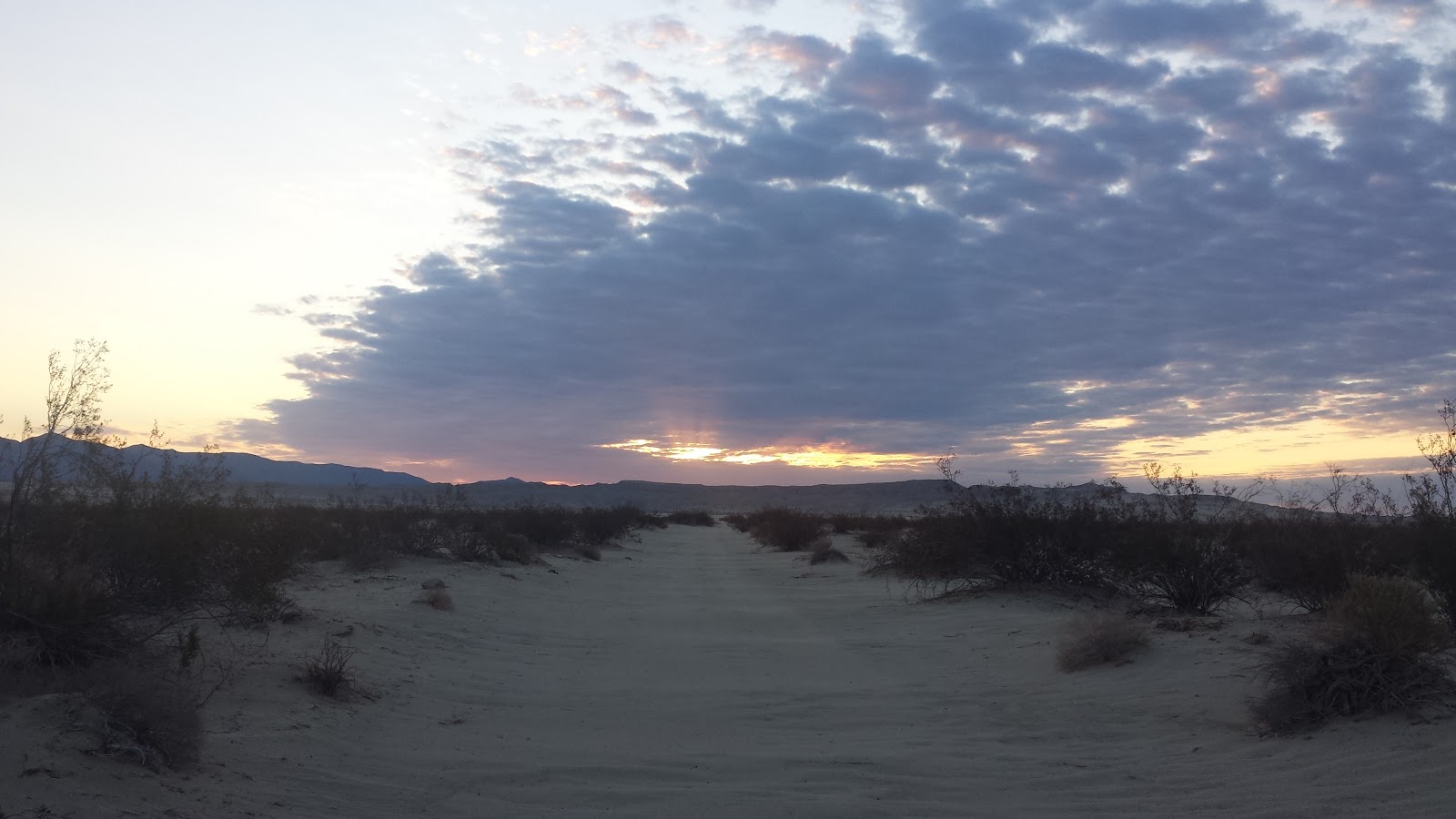
Sunrise in the Anza Borrego


This is a place of stark beauty. When you are accustomed to the density of vegetation here in the east, this place looks dead. It isn't; its just at a different pace out of necessity. Then again, if there was life here we sure couldn't find it. The best we could do was find tracks in the sand from assorted insects or reptiles. There was no sound. No sounds at all. 

Activity prohibited. ~That~ explains it...
 Well this was supposed to be one of the best places for Le Conte's Thrasher. We spent a good amount of time and found no signs of life. Lisa grew impatient, and Jeff reached for a shovel and a jar of honey. I decided that it was best we moved on. And the lyrics to the song by America are obviously incorrect...

We headed back to town where we had a very nice breakfast at Los Jilberto's Taco Shop and finally scored our first birds of the day. Americrow, Great-tailed Grackle, and a drive by Roadrunner. The Great Tailed Grackles did not have a great tail, here nor elsewhere on the trip. Must be the time of year.

Dejected, but my mood elevated by the tasty repast, I pressed on with my co-conspiritors. Our next location was the Salton Sea; near the middle of the day...

When I say (it) was cool (it) was red hot
I mean, (it) was steamin'

I believe this place is described as the tenth level in Dante's Inferno. Here birders are punished for lusting after rarities. They are punished by having to wait an eternity for their eburd sightings to be confirmed. 

We drove down the road to the Sony Bono Unit, and I spied a bird I was hoping to find for Arlene. I instructed her to prepare to say 'awe'; a long protracted awe.

Burrowing Owl
This bird never fails to deliver. How can you help but like this bird? 

We continued on to the observation tower. The first good birds were Sora and Virginia Rails. From here we spotted a lot of birds in the impoundments. There was a good representation of quackage, with Ruddy, way too many Mallards, Pintails, and Shovelers. There was both Americoot and Gallant Commonule, and the expected Egrets. But the heat shimmer and distance made some birds' ID difficult so we walked out to get close looks. We added Least and Spotted Sandpooper, Pied-billed Grebe, and Killdeer. Avocet and Black Necked Stilt were nice to see especially since they were in numbers we don't see around here.

The heat was oppressive though, so we moved on to a location that local expert Guy McCaskie had clued me into. He told me that he had seen a Reddish Egret and 3 Yellow Footed Gulls at the end of Young Road.

Traveling down past the farm fields we passed impressive numbers of Black Terns and another drive by Roadrunner was here as well. Then in some wetter fields we spotted a different assortment: Great Egret, White-faced Ibis, Long-billed Curlew, Marwit, Black Tern, California Gull.


Continuing on to the end of the road, we reached the "sea", or whats left of it. A modicum of scanning and the Yellow Footed Gull was found. One. But one is better than none, and it was a lifer for them all. For me it was a BVD (better view desired) satisfied.  The Reddish Egret was a no show.

With the gull were Willets, both Pelicans, Caspian Tern, Laughing Gull, and Neotropical Cormorants. A pair of Ash-throated Flycatchers watched us from the shade  of a tree mouths agape, wondering why we were so foolish to be standing out in the 112 degree heat. Yes, 112 degrees.

Getting back in the air conditioning did not come too soon. We drove north to Obsideon Butte, where we hoped for closer looks at the Gull if we could find some, but with the water further out and the soil less than friendly to non four wheel drive vehicles, we cut our losses and decided it was best to move on to our next destination without loosing too much light. We had after all, gotten our target species.

We hit the road for Big Morongo. Last time I visited it was springtime and there was much more water. The stream was dry. We did have some good birds anyway, starting with Western Bluebird, Warbling Vireo, Black Phoebe and Willow Flycatcher. Bells Sparrow were present, but the Black-throated Sparrows really put on a show. I was hoping for Vermillion Flycatcher, but it was not to be. A lovely place, but light faded before we could get many more birds.

Willow Flycatcher
The four of us drove on to Palmdale to turn in for the night. We arrived at the Motel 6 where Lisa had made reservations for us. The rooms did not have the requested beds, and the clerk said she only had smoking rooms even though we requested non smoking rooms! Needless to say we did not stay.

I found that the Ramada across the road was only $10 more per room, so I made reservations on my app and we drove there. The place was 10 times nicer, and it had a very extensive breakfast; all in all far exceeding the $10 additional cost. Sometimes not every bump in the road turns out for the worst!

The sun sets on another great day of birding
We turned in for the night. The plan for the next day was to begin early at Piute Ponds. This was reputed to be an excellent place to bird, and also supposed to be a good place for my continuing Nemesis bird, the Le Conte's Thrasher. I would have another chance!

Monday, September 19, 2016

The Adventure Begins! - Calibirdication Day 2

We were up and out very early but “Sunny California” as we discovered, was a bit of a misnomer. The marine layer, what you and I would call fog, was out and making it very grey. Dude, fog sounds way too gnarly, but marine layer is bitchin!
 
Never the less, we were excited to make our way to our first stop: Tecolote Canyon.  Before we did though, I pointed out Western Gull to the goils at our hotel because it was a lifer for the both of them, and the best of our first three California species, the other two being Americrows and the Rock Doves.

At Tecolote one of our first acquisitions was Black Phoebe, again a lifer for the goils; a refrain that would be repeated ad nauseam throughout the trip. But I got to enjoy the vicarious thrill of their getting a lot of great birds. We walked the lower sections because the park itself looked very closed. It payed off, as we quickly got Hutton’s Vireo and Anna’s Hummingbird, then joined by Cassin’s Kingbird, Mockingbird and the first of the anemic House Finches.

Hutton's Vireo
Here on the east coast the male House Finches have a good amount of color, but those present throughout the trip gave us pause as they were much less colored and quite ratty looking. In fact, many of the bird species we saw were disheveled, perhaps a function of wear post breeding, and underdeveloped young birds.

We walked some scrubby areas, and heard strange calls. We puzzled over who the calls could be from until we finally caught sight of California Towhees. A California Thrasher popped up not to be outdone, and serenaded us with a song that was thrasher like, unlike the towhee songs that threw us for a loop. 


California Towhee, looking for a fight with his reflection

Speaking of loops, we made our way back to the parking lot and investigated the chips notes. There were Lesser Goldfinches, but a small flock of other birds alighted in a tree and revealed themselves to be Scaly-breasted Munias, a lifer for me! Truly though, it was both exciting and not so much so. This after all, was an introduced species. Sure they sexied it up by changing its name from Chestnut Manakin, a bird I had uncountably seen in the Everglades, but introduced species just don’t have the same gravitas as native species. A yay, not a YAY! 


A nice as yet unidentified Ode


Now that some time had passed, folks arrived and the gates seemed to be open so we ventured up the canyon proper. Song Sparrow and then Bullock’s Orioles greeted us from the slopes, and then from the top of the ridge we found California Scrub-Jays. The latter Arlene continued to call Western Scrub-Jays, perhaps not up on the recent split, or perhaps influenced by the ‘out of date’ field guide. Remember when a field guide was correct for more than a year at a time?

Bullock's Oriole

California Scrub-jay
Up the canyon we got looks at soaring Red-shouldered Hawks, and more dicky birds. We had Spotted Towhee, Wrentit, and more Lesser Goldfinches. 

Wrentit
But the stars were the Allen’s Hummingbirds. Apparently they are a well known here, reliable at a home adjacent the trail, with an abundance of red flowering shrubs. We went back and forth a bit on the ID but the experts on the Pelagic we took the next day not only were very familiar with the place but insistent that they were Allen’s. It’s always good to have local knowledge.

Allen's Hummingbird

One of the main reasons for choosing this place was its hosting California Gnatcatchers. But despite our best efforts we never found them. We could have easily spent far more time exploring this place, but other birds and locations awaited us.  Especially since some of the research I had done in preparation listed a place where a much desired target species was supposed to be quite easy if one got there at high tide... And having looked into the tides well in advance, it was time to head to Seacoast Drive in Imperial Beach.

It is said that the high tide pushes the birds up to the sidewalk, and this was no exaggeration. We could see lots of birds in the expansive wetlands; the Great Egrets and the Snegrets were obvious of course. But looking at the many Willets revealed Marwits amongst them and Whimbrels as well. 


Whimbrel

We scanned from a number of vantages before coming to small promontory with an informational sign and a large cut-out of a rail below it. 

 
Well isn't this convenient?

Within moments we had a Ridgway’s Rail within a few feet of us! Nice looks, and lifer number two for me! Of course, this was a split, so again not as exciting as a non split, but then again it was a California bird for me, never having had formerly known as Clapper Rail in CA before. Yay!

Ridgway's Rail

We also had YC Night Heron, Caspian Tern, Little Blue Heron, Brown Pelican, Brant’s Cormorants, and American Bittern. Making our way to the end of the road we scanned from the boardwalk / platform and found a perplexingly plumaged bird. We eventually ID’d it to Long-billed Dowitcher, but not in any plumage I’d ever seen. 


We walked over to the beach entrance, and I was very pleased to see a Heerman’s Gull, and to point it out to the goils. It is one of my favorite gulls. It is just a sharp looking bird, and one that can make anyone love gulls.


Heerman's Gull

These are the goils, not to be confused with the gulls, though both will try to steal your french fries.

Shortly thereafter we noticed another birder and we engaged him in conversation.  What else happens when the four of you are the only folks around with binos and scopes? He was a Brit and was scheduled to go on the San Diego pelagic the next day as well. I cannot recall his name, but he was a heck of a birder, staying steadfastly at the bow of the boat and being both sharp eyed and extremely capable with ID. It would prove a big bonus having him aboard.

And we spotted yet more birders, one of which I recognized. It was Peter Shorebirder, from Hamster county, NY and his co-conspiritor Marc{?}. They too were in town for birding and the pelagic the next day. Small world.

Together the 5 of us revisited the Dowitcher. Funny thing was as we were trying to get them on the bird they were on an adjacent one that we had apparently overlooked before and dismissed as one of the very numerous Willets. It was a Wandering Tattler! 


From here we checked out San Diego Bay, where the goils got more lifers like Long Billed Curlew, while I managed to get chiggers. Nice numbers of Skimmers and Elegant Terns were loafing, and we also saw Western and some Least Sandpoopers. 


Long Billed Curlew
Black-tailed Jack Rabbit
The Avocets were nice to pick out in the distance, and we also found some Sanderling and Black-belied Plovers. We had hoped to see Snowy Plovers here, but since we dipped we decided to walk out along the beach back by the Tijuana Slough. 

It was a lovely walk, and found them way down the beach and but a stones throw from Mexico. We also got close looks at an unhappy Brant’s Cormorant. It was ill or injured; otherwise not a bird expected to allow such close approach.

Brant's Cormorant

In the surf we had a Pacific Loon, and in the ocean there were many Brown Pelicans plunge diving for fish. A nice place to be as the sun was setting. Lisa collected shells after I told her there were none on California beaches due to the surf conditions. Doh!

We ended the day by meeting up with Jeff Critter and having a nice dinner in anticipation of the next day’s adventure on the high seas.

Thursday, September 15, 2016

We’re on our way - Calibirdication Day 1

I had wanted to do a birding trip for some time, but finding co-conspirators can at times be difficult. Decisiveness is always a plus, making the making of plans that much more enjoyable. Having had the misfortune to have been coerced in to going to south east Arizona several times in the recent past, I was hungry for other locations. Sure I got a bevy of very sweet lifers on each of those sojourns, but man does not live by birding Arizona alone. Or even in groups...

You can check off birds any time you like, but you may never want to leave!
I started floating the idea of California and per usual, many were “interested” but few could or would commit. Funny thing that... but the first person with whom I got the plan to gel with is Lisa Shrimpke. Flexibility in dates was a big plus, and it turned out to be very helpful in getting in all the boat trips we wanted to do as well. Coincidentally, other QCBeasties were to be in California in roughly the same time period, but that never came to pass in a way such that we crossed paths.

I went through no less than 5 iterations of where to start and where to go next. Finally, what worked with the fixed schedule of the pelagics was starting in San Diego and doing a big loop from there. We headed east, then north, then west, and then back south.


We started in Sandy Eggo
There were a few more that we passed through, but the counties we actually birded in were San Diego, Orange, Imperial, San Bernadino, Los Angeles, Kern, Mariposa, Mono, Monterey, and Santa Cruz. Dang it’s a very big state. How lucky were we that the gas prices had fallen to levels many of us thought we would never see again, especially considering all the driving we did. 

This state is too big.

Of course a plan of this nature that entailed 2500 miles more or less over two weeks was construed by a few as “overly ambitious”. Not every place that we listed as potential sites to bird were visited of course, but a plethora of places was put in the itinerary in the event that plans had to be modified. And they always do have to be modified one way or another. Trust me...

My forte is logistics, because navigating distances and allotting ample time without forethought can waste the oh so precious birding time. That and making sure the place you want to visit is open when you will be there! Lisa’s forte was mining eburd. Together we put together an awesome itinerary. Arlene Rails found the all important brew pubs.  


As we were splitting expenses, I found an app on googull play that made doing the math unnecessary called 'Trip Expense Manager'. Also very helpful was a navigation app called 'Here' maps. Useful because googull maps only works with a live data connection, and that is something hard to find in the wilderness. Here's maps and navigation are available offline. 

In preparation, I had made an extensive map in 'googull my maps'. Great in places with data, not so useful in places without. I foresaw also listing the GPS coordinates of all the places I had mapped so that when needed we could still navigate to them, because paper maps are so passe. With a data connection its nice to see the places plotted and their proximity to the other places.

Other folks that expressed interest dropped out, but Jeff Critter eventually decided on joining up with us after revisiting Arizona {where else?} for his “warbler big year” and Arlene Rails eventually got the okay from work to get the time off and so it was the three of us for the Calibirdication, with Jeff also doing a small part of it with us at the onset.

Of course we had to fly there and back. We flew on Deltuh. What an awful company. Think of the most horrid expletives that one could utter such that you would be mortified if your mom heard them. Multiply that to the third power, and that begins to approach how much I despise that company. We were delayed 2.5 hours because they forgot to load dinners for the pilots. Nice. On the intercom they told us: “ You wouldn’t want to work without being able to eat dinner, would you?”  You cannot be responsible enough to pack dinner and I am to entrust you with the operation of an aircraft? Air travel is far worse than taking the bus. Oh yay. And this is not the fist time they screwed me over.  Lest I forget, their website wouldn't accept Lisa's membership number so we had to pay for checked bags. Fortunately on a long leg of driving I was able to call in and get it rectified. I was only on hold for 40 minutes, but it was along ride and the time was there to kill...


Need I say more?
Accordingly, we arrived later than planned and despite getting a bit lost in San Diego we eventually made it to our hotel where the staff of the Vagabond Inn was friendly and facilitated our passing out in short order in anticipation of the next day’s adventures commencing. 

I chose this place because of the proximity to the dock from where we would be taking a pelagic in two days; negating the need to find a place to park nearby as we could walk to the dock from the hotel. The cost was reasonable too, and when I told the staff we were birders and that we would be leaving much earlier than they normally set out the continental breakfast, they accommodated us! That's service!
 

Wednesday, August 10, 2016

Turtles and Sharks and Whales, Oh My!

Every summer for the past few years we have been taking at least one but usually more than one trips to see whales and of course sea-birds with Artie Kopelman of CRESLI. He operates his trips out of Montauk on the Viking Fleet. For those that are not so keen on doing pelagics because of a tendency towards the 'technicolor yawn', the boat we go out on is very large and thus very stable.  

In the winter Artie also does seal walks at Cupsogue county park. And no, you do not have to pick up clean up after the seals.

The QCBeasties         photo by Nancy Trogan

A nice group of us got together on what turned out to be a perfect day to be on the ocean. Steve Tanager, Kurt & Stacey Meyer's-Friarbird, Nancy & Lou Trogan, Pelican, Dunlin, yours truly, and a few guests.

The rain of the previous day gave way to a clear sky, modest temperatures, low wind, and flat seas. Stacey was particularly pleased! 


The Kraken attacks!
As usual, the birding as well as the whaling started out slowly, but who doesn’t like a leisurely cruise in the ocean? Of course we had Herring, Great Black-backed and a few immature Laughing Gulls with Common Terns curious about our boat. But it took a while of sailing south west before our first pelagic species showed up.

Wilson’s Storm Petrels were the first to be spotted. They were here and there and as long as one looked through binos, they were everywhere. As we got closer to the immense and numerous schools of Bunker, we caught sight of our first Shearwaters. Cory’s and Great were around first in ones and twos, and then in big groups. The largest was a flock of 100+ or so Greats loafing near a trawler, perhaps resting and digesting. 


Wilson's Storm-Petrel

There were also groups of Corys, and one such group also held two Sooty Shearwaters: one of our target birds! We were hoping to be graced with more rare species like a Manx Shearwater as had been seen on a trip the week before, but we were not as lucky.


Sooty & Cory's Shearwater - Photo by Nancy Trogan
We did see a loggerhead turtle, and numerous sharks. Some of the later were swimming at the surface, but most were thrashing through the schools of bunker.

The first whales we saw were Humpbacks. The ‘blow’ was spotted by Artie and his team of volunteers, and the captain of the boat brought us nearby.  It was wild to see the big tail fluke come out of the water as they began a dive. At one point we were close enough to one of them when the whale exhaled and Artie warned of the impending stench. Yech!  Or at least that’s what he claimed: the stench came from his direction. How ~convenient~ to blame it on the whale...


L > R     Cory's, ??, Cory's, Great
In the photo above I noticed that one of the birds is smaller in structure. Does this mean that one of the birds that have been split off of Cory's Shearwater can be present in our waters? Has anyone ever bothered to look for these very similar looking birds? It was only after reviewing my photos that I noticed the possibility...

" A large shearwater, in general structured like a Cory’s Shearwater with long bowed wings. However, bill, head and body thought to be slimmer than Cory’s in the field.  Photographs prove bill head and body were obviously slimmer than Cory’s. Note that Cory’s averages 46% heavier than Scopoli’s."

Some references: 
http://www.scillypelagics.com/scopolis.html
https://www.britishbirds.co.uk/wp-content/uploads/2014/05/V103_N12_P712%E2%80%93717_A.pdf
 
It would be nice if we could be afforded the time to study these birds that were loafing, but the goal of the cruise was alas, focused on the whales. We cruised around and eventually came across some Fin Whales. Neato! 

Overall, as compared to other trips, there were not as many whales, but the waters were calm and allowed good looks at the ones present. So far, whale wise and bird wise we have not been disappointed, though some were hoping to come across dolphins that we usually have.


At one point a young Brown-headed Cowbird inspected our boat, but due to its being littered with people, it never seemed to find a suitable place to land. Some time later, same thing but this time it was a Yellow Warbler.

As it eventually got towards that time of day, and Artie mentioned that it was time to head back. Pelican and I were scanning the ocean and remarking about the huge schools of bunker when she spotted and called out ‘whale!’ When it resurfaced, it looked quite small to me so I called out dolphin but was corrected by Artie Kopelman who called it a Minke. I thought, who does he think he is, Inspector Clouseau?

But of course he was correct, noting that it was a particularly small individual. We spent a while getting looks at it and returned later than usual to dock because of finding it late in the day.

All in all a fantastic day out on the water. Great conditions, 4 lifers each for Kurt & Stacey, year birds for the rest of us. And no one on this crowded boat got sick except for one poor slob who wretched almost continuously. We took turns trying to identify the internal organs he was expelling;  I saw a kidney for certain... 

Thursday, July 7, 2016

Serendipity to the 4th Power

At times of birding doldrumnity, thoughts turn to chores and other unsavory activities. That is unless one is torn away kicking and screaming by an offer to bird. Despite a vague "Do you have any ideas" I gave in to 'peering at bird' pressure at the suggestion of Phil Jabiru since no one was around to kick or scream at.

We decided to try Smith Point to begin with. Conditions were disappointing. Low visibility due to fog and haze, lack of water in the impoundment, and a general lack of birds made the heat and mugginess more difficult to ignore.

The final straw was inability to see out into the ocean, so we packed up with thoughts that Cupsogue might bear fruit. A check of the intertubes on the way to the car enforced that decision, as Brown Pelicans had been reported earlier.

We made our way there, while Phil called Matt Bicknell to find out where he was. Turns out, he was out fishing in the bay, so we planned to touch base with him when we arrived.

In the parking lot, an update came through the intertubes from Patrick Pallas Reed Bunting. A few text exchanges with him later, and the message became "I'm in the car in front of you".  Next, Pat graciously offered to drive us out the 4wd access road to where he had located the birds. We got out at the end of the road and quickly found the four birds on the sand bar in the bay, and got scope views.

We also noted that Pat was dressed to the nines. Turns out he took a 'break' from work to come see the birds. "Your honor, I request a recess." "A recess? On what grounds?"  "Brown Pelican". "Brown Pelican?!" " No your honor, four Brown Pelicans! 

Brown Pelican
We thanked Pat, and bid him adieu, while Phil looked out on the water and noticed Matt's boat on the water. Pat took off, and we headed to the shore to meet Matt. 

Matt had not seen the Pelicans yet, so we pointed him in the right direction and we went for a closer look. As we approached the south side of the bar we noted a paler Tern with a black bill. Roseate! This was a much desired bird for us all, and another good day bird. 

Matt maneuvered his boat to get us a bit closer without getting stuck in shallow water, and I was able to get a few pics with my phone; neither Phil nor I wanted to bring our cameras on the small boat. 

We cruised around a bit more, saw a Western Willet which stood out next to the others, and stopping at the marsh edges we saw quite a few Seaside Sparrows, but not a whole lot more other than usual suspects.

What a fantastically serendipitous day!

Thursday, June 9, 2016

Gargany Me With a Spoon

 So a Gargany was found this past Sunday, June 5, a mere 315 miles away at the Knox Marselles marsh section of the Montezuma NWR. A twitch Monday was out as it is a work day, and this Monday was  especially out as I had surgery scheduled to repair an  inguinal hernia. Being a powerbirder takes guts, and I am apparently bursting at the seams with guts. 

Monday was also a nail biter as birders everywhere were checking the ever proliferating and unnecessarily redundant venues for updates. Was the bird ever relocated? Where are the updates? It was not until late in the day that reports came in that yes, (phew) it had been re-found. This news came a bit too late for some that had the opportunity to bolt up there on that Monday, but had decided or needed to depart prior to its being located.

The pattern of behavior that emerged frustratingly late was that the bird becomes visible towards the end of the day. Gaaah! But having received word that the bird stuck, posse formation began in earnest. Pelican contacted me in the evening, while I was convalescing with quite the sore abdomen and an even sorer throat from the procedure I had undergone earlier in the day.

Once knocked out, they intubate you for anaesthesia purposes. But since you are already knocked out they apparently just jam the breathing tube down your throat in a brutally rough manner. How is it that my throat hurt so much more than where the surgery was? No matter, there was a bird we needed to see! The planning was underway.

Earic Miller had also previously expressed interest, and Pelican had indicated that John Gaggle-o-geese was on board as well. It was not until late that night that John responded to my text, and I found out he had already gone! Unfortunately he didn’t get the bird, and would not be joining us for another try. 

Early Tuesday morning I met Pelican at her place, and we collected Earic in Queens. She graciously agreed to drive as it was suggested that I not do so for more than short distances. Not that I was worried about overexertion, but as it turns out I had significant difficulty moving due to the residual effects of the laproscopic procedure. They inflate you with CO2 and some stays inside after they are done and it really is irritating; the result makes getting in and out of the car painful if I had to bend or twist. Or cough or sneeze.

We chose the  17 / I-86  route. No matter what time of year, it is a superbly gorgeous scenic drive. I navigated and performed my maddest DJ skills, but Earic didn’t step up to the plate with snacks and beverages - sheesh, ignorance of road-trip protocol...

After a while I put on one of my favorite albums: Spectrum by Billy Cobham. It has almost always been one of the first albums listened to on these epic journeys, but we were well on our way. I ascribe my success at finding the target birds with listening to this album. Listening to it this late in the trip though, would it still have its magical effect?

We made a pit-stop in Hancock, NY at the roadside rest, and in addition to leg stretching, we got several birds right from the lot including Cedar Waxwing, Warbling Vireo, and Chipping Sparrow. Earic also heard a Redstart that I not surprisingly, did not.

We continued on the rest of the way, and arrived at East Road where we found Zach Saw-Whet Owl amongst other birders. We hoped that the intent scoping was a positive indicator but it was just intent searching through the many birds out in the marsh.  


It was a process to pick through them.  Zach pointed out a Sandhill Crane for us, and the Trumpeter Swan and Snow Goose. We also got three Black Terns, so it was starting out well with several targets easily obtained. Boy were there a lot of Mallards, and the most Wood Ducks I have ever seen in one location. 

After some time, someone stopped by and said he had the Gargany that morning from the infamous Towpath Road. Not sure if that ever got posted anywhere, and not sure why. An ABA code 4 bird and not more than one or two posts on all the lists? WTF?? Come on upstate birders, we can do better than that... Zach also informed us that there were other goodies there, and we decided to try our luck after exchanging cell numbers.

The Towpath road was a challenge to traverse. For Pelican, it was for doing her best to pick the best path and stay out of ruts etc. For me, it was the jostling of my belly that made me wince repeatedly. Earic and Pelican did their best not to laugh too loud or too often.

At the clearing we saw Common Gallinule and heard Least Bittern, as well as Orioles, Yellow Warblers, and Catbirds. We gave it some time, but if there was a Gargany there we sure couldn’t see it.  We also saw Green winged Teal, Blue-winged Teal, Wigeon, Shoveler, and Pintail. After a while as many as five Bald Eagles appeared over the marsh, and put up all of the ducks. Couldn’t pick out our target in the melee, but a sight to behold nevertheless.

We decided to try birding elsewhere and met up with Willie Diademed Sandpiper-Plover on the way out.  He and his party took up station at towpath after exchanging cell numbers, while we went to the visitor’s center.

The visitors center gave us Martins, a bird I had missed on the Doodle-ing Bash trip. Not a lot else and it appeared very dry. Add to that a creepy guy shouting out bible rantings and we departed in short order.

Much to our chagrin we discovered the wildlife drive was closed for repairs and was fenced off. We headed back instead. On the way we stopped at Armistead road where we looked for a reported Prothonotary, we found a male and female Cerulean in consolation.

Oh well, we decided to head back to East Road to give it another go. After all, it was getting near the time the bird was ~supposed~ to show up. Zach was still there, as was a group of other birders. No luck yet. And then Menachem Goldfinch and his mom showed up, as did Patrick Pallas Reed Bunting. The birders, not to mention down-state birders,  were coming out of the woodwork; would the Gargany?

We were assembled so that we could search the south west corner of the marsh. We began scanning in earnest again and then after a short while Earic said: “I think I have the bird, let me look in your scope Pat”. He looked through her superior optics, and said: “That’s it!”

I looked through his scope to find landmarks, then through mine and confirmed it was the bird. Holy excrement! The bird was sleeping with its head tucked backwards on its back. How the hell did he find it, especially with that scope of his? Its just a cardboard tube with the bottom of a coke bottle taped onto the far end.

Earic ~heard~ it of course. I overheard him say that “Its snore sounds similar to,  but different from Green-winged or Blue-winged Teal, so I knew it had to be the bird.”

After getting a good look I yelled out to the other birders that we had it, and the mad dash of excited birders gathered round. The distance, the obscuring vegetation, and the wind made observation a challenge. That’s why we had set our selves up sheltered by Pelican’s car. It became most expedient to let the others look through our scopes rather than try to describe the location. 


It was a lifer for almost all present, though for me it was only a NY State bird having seen one in 1997 in NJ. But it is NYS bird # 414 for me. Sated by our views of the bird, we went in search of food. We stopped in Auburn at Parker’s Grille & Tap House for the requisite celebratory beer and a hearty and well deserved repast.

Happy birders! A great end to another epic journey, with great weather, great scenery, and great birds. And the spotting of the bird later in the day was no doubt due to the delay in listening to Spectrum. I’ve learned my lesson: play that album ~first~ so we find good birds without delay!

I have to thank Pelican for doing all the driving. What a trooper! Earic offered to spot her a few times but she is no slouch and said 'no need'. There was a point at which he and I were asleep while she drove on in solitude. Not a birder to be trifled with, in my opinion the epitome of what is being strived for in the article about “female leadership in birding”, on the ABA's blog. On the other hand, twice she made me laugh so hard my belly hurt. Its weird to go from laughing to wincing, but she seemed to enjoy watching me do so.

Gargany Me With a Spoon? Uh, yuh, totally.